What private equity ownership doesn’t tell you
The role of private equity in hospital, health system, and medical group ownership has received increasing coverage over the past few years, spiking any time a PE firm makes a big acquisition. And let's face it: the news coverage is frequently negative.

At a glance
Read on to get our full commentary, or use the links below to jump to a specific area of interest:

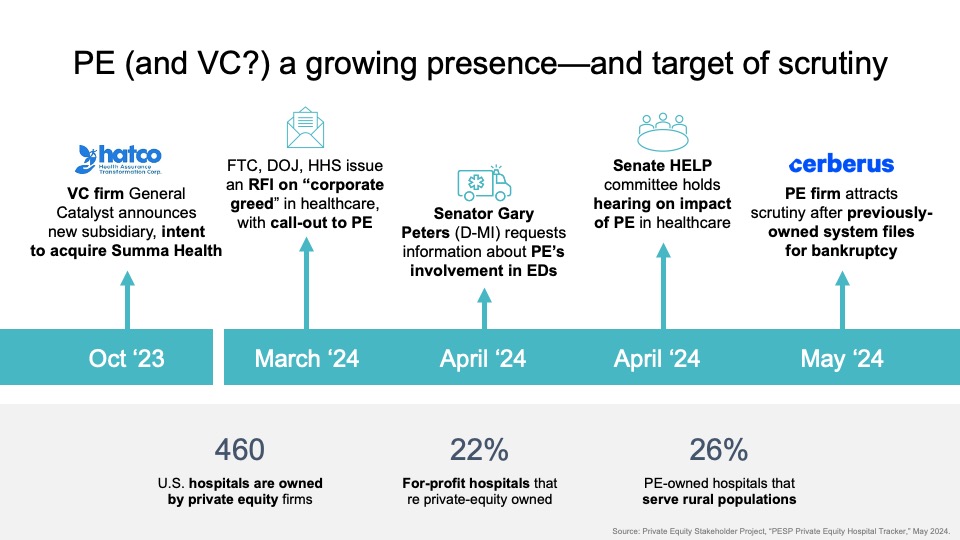
The role of private equity in hospital, health system, and medical group ownership has received increasing coverage over the past few years, spiking any time a PE firm makes a big acquisition. And let’s face it: the news coverage is frequently negative. In the past three months, government scrutiny of PE’s involvement in the healthcare world has ratcheted way up, driven by some high-profile struggles and failures surrounding both PE stewardship, and more important, exit strategy. In particular, the PE penchant for funding acquisitions by debt that has to be paid down by the acquired entity has been increasingly seen by media observers as an unsustainable financial burden. These challenges have prompted a series of scholarly policy recommendations (Health Affairs subscription required) aiming to increase regulatory oversight, increase reporting requirements, and restrict flexibility around staffing and future buyers. I’m here neither to pile on nor to excuse those failures, nor to endorse or reject any recommendations.

Union Healthcare Insight
Log in to continue reading
Not a member yet? Create a free account for limited access.

Let’s talk.
Questions? Want to learn more about what Union can do for you? We’d love to hear from you.
Related insights
The new patient financial reality

The Great Utilization Shift
How one health system is creatively pushing back against a labor squeeze